Friday, October 30, 2009

Cajitas: Great Workshop!

On Saturday, October 24th I lead a Day of the Dead workshop at Galeria de la Raza. I provided participants with small postcard sized wooden boxes and a variety of embellishments that included plaster miniatures, specialty papers and other collage elements.

It was really a joy seeing friends and families working together!

Everyone was working so hard...But it seems like they were also having a good time

The themes of the boxes varied from traditional Day of the Dead designs to personal dedications to family members to a fantastic box with an environmental theme, in honor of our dying planet. Thanks everyone for participating!


And thank you Galeria de la Raza! Click the link to visit Galeria's calendar of events

Monday, October 26, 2009

Chile Wreaths and Etymology


I was in Seattle recently for work and I got a chance to eat lunch at the famous Pike Place Market. After walking around I made my way to Post Alley and El Mercado Latino. This is rainy Seattle not New Mexico so I was surprised to see many gorgeous chile ristras and wreaths in so many shapes and colors! I took some photos for your enjoyment. All these chiles inspired me to write on the origins of the word "chile".


Chile or Pepper?
Christopher Columbus was the first European to encounter plants from the genus Capsicum in the Americas. In Spanish these plants came to be known as chiles (from their original Nahuatl name, chil). Columbus tried to pass these plants as the same spice known to Europeans as pepper. At the time pepper was highly priced in Europe, known as a spice, a preservative and a medicine. Black pepper (Piper Nigrum) is however from the family Piperacea, a spice native of South India. Columbus may have thought Capsicum and Piperacea were the same, since confused Europeans believed to be in India when the "new" word was first "discovered". This is the reason Native Americans are erroneously called "Indians", and why in English we are stuck with the same word (pepper) for two different plants.


Chile or Ají?
The South American country of Chile is long and skinny...but it is NOT named after a chile.
The name of the country has different roots than those of the chile pepper, originating from the Quechua chilli, a combination of the words "Chi", meaning trascendental and "Levu" (shortened to "Le"), meaning river. Loosely translated it means "The River of the Ancestors". Curiously, in South America the Spanish word for hot pepper is Ají picante, as opposed to chile, as it is known in Mexico and other North American Spanish speaking countries. However in all Spanish speaking countries black pepper is called pimienta a word similar to the Spanish word for bell pepper: Pimiento.


Chili or Chile?
"Chili" is the anglicisation of the word Chile, and it is used only in the US. It is also the name of the popular Chili stew made with meat, chiles and some times beans. The dish has its roots on food eaten in Mexico for centuries, basically meat seasoned with chiles, or "carne con chile", by its name in Spanish (literally it means "meat with chiles"). In the American Southwest the name of the dish (and the dish itself) went trough a reincarnation and became "Chili con Carne", or the powdered spice blend used to season this dish. The good folks of ChileTraditions mention that in 1983 New Mexico Senator Pete Dominici made an official congressional record on the correct way of spelling Chili: With an "E" at the end.


More fastidious chile grammar and slang
English speaking folks usually say "chile rellenos" or simply "rellenos" when referring to the dish consisting of battered stuffed peppers. The plural of the Spanish word would be "ChileS rellenos", if there is more than one.

So, rellenos or not, how HOT are chiles really? The chemical called capsaicin in the chile stimulates the papillary glands and dermis and produces a "burning" sensation, and make you release endorphins, creating a reaction similar to heat exposure. The chile itself doesn't produce heat. Eating chiles while in the middle of a snowstorm won't save you from hypothermia.

The spiciest chile is probably the Habanero. It is spelled HabaNero, not Habañero, since it is named after the city of La Habana, where the chile was traded. The origin of this chile, however, was the Yucatan peninsula and it is featured in many delicious Yucatecan recipes.

In Spanish when something is spicy it is called "picante", from the word "picar", meaning something that pierces like a needle or stings like a mosquito. In Mexico the word chile also has sexual connotations, it alludes to the penis.

So my friends...Al Chile (A slang saying, meaning: To the point!)

If you go to Mexico don't ask for chile "caliente", if you are expecting something spicy - you'll just get something warm. If you are a guy, don't ask for someone to heat your chile, unless you are expecting...Oh, never mind. If you go to Seattle, make sure you visit Pike Place Market.

Happy eating!

Monday, October 12, 2009

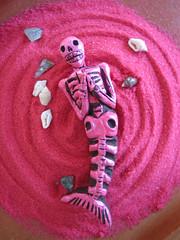
New Day of the Dead Figurines


Pink Skeleton Merman
Originally uploaded by kool_raul
Just on time for Dia de los Muertos! Some of my Day of the Dead figurines are now for sale at Martin's 16th Street Emporium.

Visit the emporium at:

3248 16th Street. Just a block away from historic Mission Dolores in San Francisco. Open Thursday, Friday and Saturday from 12:00 to 5:00 pm

Tuesday, October 6, 2009

Toasted Pasilla Chile Soup Base


In the past few years smokey chipotle peppers have gained a lot of popularity in the US. It is not hard to find South West, Mexican and "fusion" recipes that call for chipotle peppers. I think it is a matter of time before pasilla chiles gain the same popularity north of the border. Like many other Mexican chiles, pasillas are sold dry. Some times pasillas are mistaken for ancho dry chiles. You can easily recognize pasillas because they won't be as long and skinny as other dry varieties, and they will be very dark, almost black. They are also very wrinkly.

Dry pasillas may require a little bit more preparation before they can be added to your recipes, but don't let that intimidate you. The extra steps are well worth it. "Pasilla" is a derivative of the Spanish word "pasa" or raisin. When properly prepared, pasillas add a robust flavor to your dishes and a hint of fruitiness reminiscent of raisins or sun dried tomatoes. I like frying pasillas in a pan first, since it produces an earthy hint of dark chocolate and a toasty flavor that is very different from the smokey chipotle. Depending on the pasilla variety, they also pack a lot of heat, so a little goes a long way. You'll need the following ingredients:

  • One dry pasilla chile (or two, if they are small)
  • One clove of garlic, peeled and mashed
  • A quarter of a small onion, chopped
  • One tablespoon of olive oil
  • One large tomato, or two smaller Roma tomatoes
  • Salt, to taste
  • A pinch of sugar
  • One bay leaf

Tear the dry pasilla chiles in half, discard the seeds. Use a small paring knife to remove the stem and the veins. Tear the chiles in smaller pieces. Wash your hands carefully before proceeding to the next step.

You need to toast your chiles in order to "wake up" the flavor. This takes a bit of skill and could mean the difference between a toasty flavorful soup base and bitterness and indigestion. First, heat the olive oil in a non-stick pan. Make sure the oil is very hot but don't let it smoke. Fry the dry chiles for a couple seconds. Using thongs turn the chiles and fry them on the other side, making sure they don't burn. Work in a well ventilated kitchen. Depending on how spicy the chiles are they'll produce a sweet mellow scent or smoke that can feel quite toxic! Don't breath the fumes directly, they can irritate your eyes and throat.

Put the toasted chiles in a bowl and set aside. Saute the onion and the garlic in the same pan where you toasted the chiles but don't let them brown. Turn the heat down and add a cup of warm water to deglaze the pan. Pour the warm water, the onion and the garlic in the same bowl with the toasted chiles and the bay leaf and let them soften for a whole hour. Once the chiles are soaked they will be very soft and the water will be a nice amber color.

Remove the bay leaf and discard. Blend the chile mixture with the peeled, seeded tomatoes until smooth. Add salt to taste and a pinch of sugar to cut the acidity. Strain in a fine mesh sieve. You can store your soup base in an air tight container for several days. Use this base as a spicy vegan "bullion" in soups like pozole, rice, sopa seca or any other pasta dish, as well as chili. You can even add a few drops over tostadas, potato salad, or home made salad dressing.

Monday, September 28, 2009

Cajitas: Day of the Dead Boxes Class at Galeria!

On Saturday, October 24th, I will be teaching a class on how to decorate your very own mini Day of the Dead box! The class takes place at Galeria de la Raza, from 2:00 to 5:00 pm. Make sure you call Galeria ahead of time to reserve your spot.

Description:
Create a memento, a shrine, a love token for the dearly departed, or just a funny vignette in a Day of the Dead theme. Using a small wooden box and a variety of collage materials you'll create a fantastic mini treasure to take home.

Fee and materials:
$30 per person. Includes a 5x7 wooden box. Also included are unpainted plaster skulls, hearts, angels and other ornamental embellishments ready for you to paint. Lots of collage images too! I will teach you how to make lacy miniature "papel picado" and mini paper flowers. No previous art experience is necessary. Feel free to bring photos or your own personal ephemera to embellish your box.

Registration/Location:
Please call Galeria to reserve your spot. Class is limited to 12 participants. Children with an adult assistant are welcome to participate. The class will be conducted bilingually, in English and Spanish.


Cajitas: Mini Day of the Dead Boxes

Saturday, October 24th, 2009

2:00 - 5:00 pm

Galeria de la Raza
2857 24th Street
San Francisco CA 94110
Phone: 415-826-8009
Email: info@galeriadelaraza.org

By BART: Take the BART train to the 24th Street Station. You will emerge on Mission Street and 24th Street. Go East on Mission Street. Walk for about 15 minutes until you arrive at 2857 at the corner of Bryant. You can also catch the Eastbound 48 bus at the corner of 24th and Mission; get off at the corner of Bryant Street.

By MUNI: Take the 14 Line or the 49 Line to 24th Street. Exit and go Eastbound on Mission Street. You can then catch the Eastbound 48 bus at the corner of 24th and Mission and ride it to Bryant Street. You can also walk for about 15 minutes until you arrive at Bryant Street.

Wednesday, September 23, 2009

Ronaldo Fraga: Fashion, Cartoons and Disney


What do theme parks, Mexican paper banners and fashion can possibly have in common? I would say a whole lot, after seeing the work of Ronaldo Fraga. Fraga is a Brazilian designer, his collection "Disneylandia" was part of Sao Paulo's fashion week. For his latest collection Fraga created an exuberant mishmash of Latin American folk tradition, theme park imagery, Disney kitsch and a bit of mid-century illustration. In the artists own words:
"My eyes melt with the thought of Mexican fiestas, Colombian textile handicrafts, emotional Argentinean cinema, Olinda’s carnival and its confetti and serpentine throws, and writings of Borges, Drummond, García Marquez, and Cortázar… all fronts of cultural resistance in a slippery world without frontiers. I think about how we, Brazilians, interact with our next-door neighbor – Miss Latin America –, who we barely greet when we meet in the elevator every day. In this collection I attempt to exchange cups of sugar with a neighbor who does not speak my language, but whom I can talk to through music, a graphic universe, political and religious discomfort, and the feeling of a possible place in the contemporary world."

A rickety wooden catwalk was created for the fashion show. The many passages made it resemble a labyrinthine favela, or Brazilian shanty town. The model's look was that of "Meme Mau", or what a friend of my grandmother's used to call the bastardized Mexican version of Minnie Mouse, by sporting enormous hair knots that resembled Mikey ears. Collars made out of little "chiclet" boxes, richly embroidered jackets, dresses stamped with Disney characters and Latin American flags were included in the collection. All the models had powdered pigment dusted on their foreheads, making them look as chimney sweeps from the movie "Mary Poppins". The pigment could allude to a splash of paint or the vitality that creates an animated character, or the ash people in Latin America wear on their foreheads during Ash Wednesday: Ashes to ashes, dust to dust. Powdered pigment, to powdered pigment?

Death and other different layers of meaning pop-up in the imagery of Fraga's accessories, like the above pictured "La Muerte" lapel accessory from La Loteria, the popular Mexican bingo game or these skeletal Mikey Mouse pendants:


The collection may be best remembered for its amazing dresses inspired by "Papel Picado" or paper banners created for Mexican holidays. Fraga seems to specially like designs with skulls traditionally used during the Dia de los Muertos, or the Day of the Dead holiday. Papel picado in its ethereal fragility alludes to death and mortality. In this case, fabric mimics paper.


This collection may also have a connection with mid-century illustration. Some of Fraga's folky "boho chic" creations show influences from traditional "huipiles", or roomy blouses and dresses worn by women from the isthmus of Tehuantepec. The style of the Tehuana, what the women from this region are called, is often associated with Mexican painter Frida Kahlo, who popularized the look during the 1940's. The Tehuana costume also inspired Mexican illustrator and ethnographer Miguel Covarrubias (1904 - 1957) and American designer Mary Blair (1911 - 1978).

Tehuana Inspiration


In the US, illustration styles of the 1940's to the 1960's reflected curiosity and discovery. The space race and the ability to travel to exotic locations fascinated North American audiences. Both Covarrubias and Blair benefited from travel and study "on site". Covarrubias spent years researching Olmec culture and the people and traditions of Tehuantepec, Oaxaca, where the Tehuana costume originated. He had a theory that the native culture of Mexico diffused as far north as the Mississippi delta, and as far away as Easter Island. Here is one of his illustrations for his book "Mexico South", published in 1946.


Covarrubias was a successful illustrator and cartoonist. His work was published by The New Yorker and Vanity Fair. Like Blair, he was also a talented colorist.

Mary Blair also spent some time in Mexico studying painting, before going to work for Walt Disney in 1940. She later joined her husband, Lee Everett Blair, other creative professionals and Disney himself on a gig traveling to several Latin American countries. The project was sponsored by the federal government under Franklin D. Roosevelt's "Good Neighbor" policy, that was meant to oversee Latin America in a more "benign and peaceful" tone after years of interventionism. It was also meant to prevent and discourage anti-US sentiment. The reasons for Disney to participate were many. It was an opportunity to promote his studio using Uncle Sam's money, since the studio was strapped for cash. His artists researched the studio projects that would later become Disney's animated "The three Caballeros" and "Saludos Amigos". Here's some concepts created by Mary Blair.


Mary Blair moved on to create designs and concepts for some of Disney's classic animated movies, among them "Cinderella", "Peter Pan" and "Alice in Wonderland", but her aesthetic was forever influenced by the folklore and the color of Latin America. She was also the creative force behind the ride "It's a Small World". Originally one of four Disney sponsored attractions for the 1964 World's Fair in New York, the beloved (and at times hated) ride was also created from concepts developed by Mary Blair.


Much like "Its a Small World", Fraga's "Disneylandia" speaks to us of optimism, unity and nationalistic harmony in Latin America. But is real, or just light, glitter, plywood and paint? Is the perennial Carnival-like vision of Latin America gone, making way for cultural understanding, or do we still delight in the make believe cha- cha land, complete with margaritas and an obnoxious "hot tamale train" to ride on? Personally, I just think of the artisans, weavers, textile and garment workers in Latin America, and those of Latin American origin working in the US industry, and question the real role of indigenous artists in the fashion world. Ronaldo Fraga tells us of a different Latin America that has possibly arrived to the international design and culture arena on its own terms:

"Now I look at the neighbors of a Latin America I am not familiar with, an America different than the one with cucaracha generals and dictators who were lost in time, and different than the one who is denied a US visa or bears the heavy burden of corruption".
I would add one caveat - the more that things change, the more they stay the same. Maybe the process has also gone full circle. A fashion designer inspired by a theme park; a theme park that drew inspiration from an illustrator, an illustrator that found her inspiration in the colors of Latin America. Small world, indeed.

Links and photo credits:
Check out Ronaldo Fraga's Flickr Photostream to view more of his work. You can also visit the designer's blog. Other photos by Camilo Gutierrez via Camilogr.com

The Covarrubias illustrations from "Mexico South", now out of print, come from the literary blog Bellemeade Books

The Mary Blair illustration comes from Littleverses. It includes photos from Mary Blair's Latin American trip from Life magazine, and more information about how her concepts helped influence Disneyland's look. Additional images by Peko-chan

This link is about the controversy of redesigning the ride "It's a Small World" by adding Disney characters and a patriotic "Up with America" sequence, and tampering with the original Mary Blair concept.


Tuesday, September 15, 2009

Sacred Fluids: The Real History of Chia Pets


Chia Pets! They are impossible to miss during the holiday season, and they may be some of the least known cases of cultural appropriation. Widely available at chain drugstores, they are the kind of last minute generic gift you'll give someone out of obligation or... lack of shopping time! It is no surprise that the manufacturers of Chia Pets are San Francisco based Joseph Enterprises, Inc. creators of the "Clapper", the practical, yet impersonal gift that turns your lights on and off when you clap. But the curious pottery animals have an interesting beginning, that takes place (like many other things I blog about) in Mexico.

Whimsical Clay in the Southern Mexican Garden
Mexicans have a long tradition of ornamental gardening, its aesthetics are often shadowed by popular gardening styles of Europe, and by the erroneous belief that Mexico is mostly arid and desert like. The lush terrain of southern Mexico allows for green gardens with a variety of plants. My parents home state of Chiapas has a diverse topography that includes sierras, beaches, lakes, rivers and waterfalls. The lush Lacandon jungle and the heat of the Soconusco region contrasts with the cool highlands of San Cristobal and Union Juarez. The garden styles includes local species of vegetation as well as many local handicrafts.

There are many types of vessels used to propagate seeds and spores in Southern Mexico. My maternal grandmother, a native of the town of Tapachula, used to give me humble gifts of hens made out of peat and bark when I was little. You were supposed to plant ferns in them, once the spores propagated, the hens would have lush green "plumage". Before someone thinks they could make millions with the proper marketing and a catchy jingle they should know that it is hard to make the ferns grow outside of the right climate. In Mexico City my hen pots never reached full vegetable maturity.

Other very popular hanging planters in Chiapas are called pichanchas, they are also used for growing ferns and other plants. The large round clay pots have many little holes in them, and designers have taking a liking for creating light fixtures with them, because of the pretty shadows they cast. Just call it a Chiapas style "disco ball". Thanks to La Camara de Akutzin for the photo of the hanging pichancha and the light fixture on the back.


Other garden ornaments include aerial orchids grown attached to boards, that are often hanged on walls like art, ornate pots shaped like doves in a variety of sizes and many other pots shaped like animals. Animals themselves are part of the garden, usually pet bids like parrots and some times peacocks, and little bids in decorated cages. But why animals in pottery? Zoomorphic vessels abound in the Americas. From birds to dogs, the decoration and shape vary greatly according to region, but clay is a common material used to create these vessels. According to the University of Richmond Museums, animal shaped vessels were often associated with Shamanism in pre-Columbian cultures: "because a shaman was believed to be able to transform into different animals during specific rituals." The image below comes from the book "Frida's Fiestas". It illustrates a clay maceta in the shape of a deer.

But back to chia, as it relates to animal pottery. Salvia hispanica is the Latin name for this plant, but the name "Chia" is a derivative of the Nahuatl words Chi and Atl, meaning something close to, or under water. The Mexica (or "Aztecs" as they are often called) were imperialists. They gave names in their native Nahuatl language to regions they conquered, in this case, the name of the state of Chiapas is probably a derivative of the word Chiapan. It means "Place near the river where chia abounds". Folks in the US are some times surprised to learn that there is an entire Mexican state named after chia! Curiously, in Chiapas, pottery decorated with chia sprouts was not very popular as garden ornamentation. Chia "pets" were originally grown out of religious fervor.

A Virgin's Tears and The Altar of Sorrows
Folks north of the border may also be more familiar with the Day of the Dead holiday and the elaborate altars created for the deceased. There are many traditions in Mexico that involve the creation of altars and Ofrendas, or offerings, for a variety of purposes and holidays. One of them is the Altar of Sorrows, created on the days leading to Good Friday, before Easter. The altar is created in honor of the Mater Dolorosa, or Our Lady of Sorrows. Prominently featured on the altar of sorrows are sprouted seeds, and pottery animals decorated with chia seed sprouts. Altar creators prepare chia, oats and other seeds in containers and sprout them weeks before the altar is created.


So, are these the original Chia Pets? Well, yes and no. Not all pottery with sprouts is a Chia Pet. Sprouts were grown in containers in a variety of shapes, not only animals. However, the idea for "Chia Pets" definitely originated in Mexico. The tradition of the Altar of Sorrows is not exclusive to Chiapas. The folks of Joseph Enterprises had the original "Chia Ram" made by craftsmen in Oaxaca, they were identical to the ones used for the Altar of Sorrows. Now "Chia Pets" are made in China and are considered "American", and have quickly sprouted (yeah, sue me!) a peculiar humorous culture of its own. Websites now have "chia cams", "Improbable Research" proving the evolution of plants into animals, and hoax articles citing ecological disaster due to illegal chia dumping.

Pottery animals are still made in Mexico for the Altar of Dolors, but to this day, some of the reasons for creating the altar are disappearing into obscurity. For example, for some mysterious reasons some pottery figurines used in altars are some times sprouted while grown in the dark, while others are grown outside. This makes some of the sprouts yellow, while others are bright green. I have no idea why this is done, maybe just for the purpose of having different shades of green to beautify the altar, or for symbolic meaning. I knew about some of the symbolic significance via oral traditions I learned from my grandmother, and also did some research about these meanings on my own. Here's some of the items placed on The Altar of Sorrows:

Candles, papel picado (lacy paper cutouts), oranges decorated with little banners, reflective round glass spheres, fruit decorated with gold and silver leaf, carafes full of colorful agua fresca (fruit drinks) and white lilies are some of the items always used in the altar. All of these items allude to Mary's attributes and sorrow: The oranges are bitter, the lilies are white to represent purity and the purple color of the banners represents mourning. Chia is used for practical reasons, it sprouts fast and when soaked, the seeds create a gel-like coating called mucilago. It is this gel-like substance what helps the seeds adhere to the moist pottery and some times even bricks are used to sprout the seeds. There is also symbolic meaning to chia. When added to agua fresca, traditionally lemonade, the little seeds covered in gel are said to resemble the virgin's tears. The shiny glass spheres placed on the altar also allude to Mary's tears. Mexico is a land of syncretism, so these symbolic meanings are very likely to predate Catholic religious zeal.


Sacred Fluids, Ixtel and The Moon Cycle
The devotion for Mary is powerful in Mexico. The Altar of Sorrows is created in the Spring, but the feast of the Lady of Sorrows actually falls on the third Sunday on September. There are many holidays that honor The Virgin Mary in the month of September. This period between Summer and Fall is a time for the completion of the harvest, when the light of the full moon allowed farmers to work at night. Many holidays worldwide have festivals associated with the moon cycle during this time, the moon itself being called "The Harvest Moon". It is a time for completion and reflection, like the Jewish holidays of Rosh Hashanah and Yom Kippur which start after the new moon of September. It is also the time when Ramadan ends - all holidays of atonement and reflection. Curiously, the second week of September, between the full moon and the new moon, has become a time for people in the US for remembrance and sorrow. Holidays during this period for many cultures mark the Autumnal Equinox, the beginning of darkness, often associated with "female" qualities.

The particular fervor for the Lady of Sorrows in Mexico may be guised in the ancient cult of the moon goddess. The mysterious goddess of fertility for the Mayans was named Ix Chel, also known as Ixtel. She was also the goddess of the moon, the rainbow and textiles. Many of her followers used to take perilous journey to her island sanctuaries near Can Cun, today the resort islands of Cozumel and Isla Mujeres, the Island of Women. Offerings for Ix Chel included pottery and atole, a gruel made out of corn and water. According to Maya myth, corn was the basic ingredient for the creation of mankind. The gooeyness of the atole probably had symbolic meanings as well.

To the Mayas, the word "Itz" meant life force. Maya scholars David Friedel and Linda Schele describe the concept of Itz in their book, Maya Cosmos: Three Thousand Years on the Shaman's Path. Itz is also a physical gooey or watery matter that appears in nature. Rain, morning dew, the water that drips from stalactites in caves, the underground "cenotes" or pools that were sacred to the Maya were believed to be full of Itz. The Mayas also knew that humans were composed mainly of water, so blood, sweat, mother's milk, sperm and tears were also manifestations of Itz.

To ancient Mexicans, chia may have appeared to be magic. After all, it is one of the few seeds that creates "Itz" when soaked in water. It could be the reason that chia became a prominent component of the altar of sorrows, because in a case of syncretism, the gel-like seeds were not only alluding to Mary's tears, but to ovaries, cells, sperm, fertility, human preservation in a time of sorrow and the primordial cosmic goo of life force itself.


Nutritious, hydrating Chia
Lately there has been a lot of talk about chia and its nutritious properties, mainly its uses as a dietary supplement due to its high content of fiber, nutrients and fatty acids like omega 3's. Chia also has more calcium than milk, and none of the cholesterol. But the most powerful property of chia is its gylycemic factor, in part due to the mucilago it produces. When ingested, chia releases a constant stream of glucose into the bloodstream, and it keeps the body hydrated. What does that mean? A secret well known to Mexica warrios as well as present time jornaleros: If you consume chia you won't feel hungry or thirsty for many hours. Maybe ancient Mexicans knew that the most sacred of fluids are the ones that help us stay alive.

Refreshing Chia Limeade - Limonada de Chia
This drink is some times called Agua Fresca de Chia, and it is made with small Mexican limes. It can also be made with lemons or other citrus fruits. When I make this, I use my aluminum Mexican juicer, it really squeezes the juice out of the limes! You can find similar ones on-line. For each 8 ounces of water, you'll need the following ingredients:

  • Juice of one lime
  • One heaping tablespoon of chia seeds
  • Two tablespoons agave nectar, sugar, or flavored Torani syrup
  • (optional) fresh mint, cucumber slices, or lime slices to garnish

Combine all the ingredients in a glass with the 8 ounces of water and shake well. You can also make several servings in a pitcher or carafe. Let the limeade rest for several hours in the refrigerator, this will make the seeds swell up and absorb the citrus flavors. Serve and garnish if desired. Stir the limeade often with a spoon, since some of the seeds will sink to the bottom of the glass. Enjoy!


I leave you with this image of soaked chia seeds. To me, it resembles a galaxy, and makes me think of bigger issues that go beyond a silly fad.


Links:
Altar of Sorrows. Here is a link to Alberto Rosher's photos on flickr. He is a papel picado artist and altar maker, creator of some of the beautiful altars pictured. Another great collection of Altares de Dolores can be found here, courtesy of Casti_go. A global journal for responsible tourism, Planeta explains more about the tradition of Altares de Dolores in Oaxaca, Mexico.
Moon Folkore. Visit Keith's Moon Page, for moon facts photos and folklore related to the moon.
Mexican Gardening. This article talks about the history of ornamental gardening in Mexico, and a botanical garden in Xalapa, Veracruz. It is called Francisco Jardin Botanico Javier Clavijero
Chia. The folks of chia power have an entire blog dedicated to chia. It includes categories like the history of chia, chia in current events and chia humor - including the imfamous "Chia Obama".